

How Does AI Count Calories From a Photo? (And How Accurate Is It?)
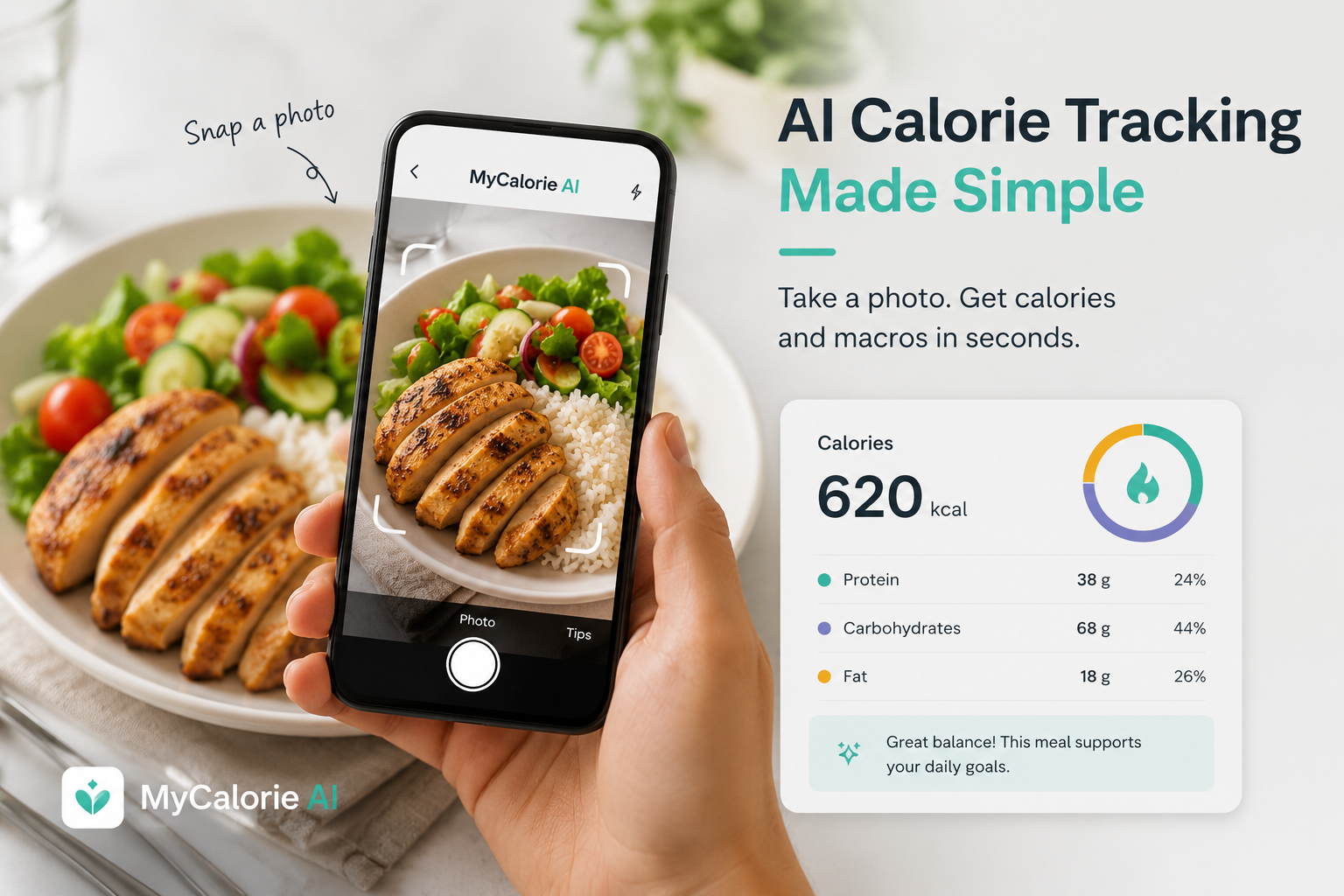
If you’ve ever pointed your phone at a plate of pasta and watched an app instantly tell you it’s 620 calories — you’ve probably wondered: how does it actually know that?
It’s not magic. It’s a combination of computer vision, nutritional databases, and machine learning models trained on millions of food images. Here’s what’s happening behind the scenes when you snap a photo in MyCalorie AI.
Step 1: The AI identifies what’s on your plate
When you take a photo, the app runs it through a computer vision model — a type of AI trained specifically to recognize food. It doesn’t just detect “pasta.” It distinguishes between spaghetti bolognese and carbonara, identifies side dishes, sauces, and toppings, and can handle mixed plates with multiple components.
This works because the model has been trained on vast datasets of labeled food images — thousands of examples of the same dish photographed from different angles, in different lighting, in different portions.
Step 2: Portion estimation
Identifying the food is only half the job. The AI also needs to estimate how much of it there is.
This is the hardest part of food photo analysis. The model uses visual cues — the size of the plate, the depth of the food, the density of the ingredients — to estimate portion size. It’s not perfect, which is why MyCalorie AI lets you manually adjust the calorie count if your portion looks different from the estimate.
Step 3: Matching to nutritional data
Once the food and portion are identified, the app matches them against a comprehensive nutritional database to pull calorie counts and macro breakdown — carbs, fat, protein, and fiber.
The result lands on your screen in seconds.
What if you don’t have a photo?
Not every meal is photogenic — or photographed. MyCalorie AI also lets you describe your meal in text (“grilled chicken breast with rice and salad”) and the AI will estimate calories from your description. Same technology, different input.
How accurate is it?
No AI food analysis is 100% precise — portion estimation from a photo is genuinely difficult, and home-cooked meals vary widely. But for most people, the goal isn’t laboratory precision. It’s consistency. Tracking approximately what you eat, day after day, is far more valuable than perfect data logged only occasionally.
For cases where you know the exact amount, the manual correction feature lets you fine-tune any entry.